Kuranda Envirocare
  • Home
  • About us
  • Projects
    • Macro invertebrates (What's in our Creeks)
    • Connecting Corridors Project
    • Bird Monitoring Project
    • Frog Monitoring Project
    • Frog Friendly Neighbourhood
    • Yellow Crazy Ants
    • GROW Project 1
  • Nursery
  • Get Involved
  • Shop
  • Tree Planting for Groups
  • Regional planning
    • Land development history
    • Kurworld >
      • TOO BIG
      • WRONG PLACE
      • NOT ENOUGH WATER TOO MUCH WASTE
      • ROAD CONGESTION
      • EMPTY PROMISES
      • NO TRUST
      • KEC Position
      • Resources
      • Submission Form
  • Invasive species
  • Local threatened species
  • Newsletter Archive
  • Contact us
  • Citizen science blog
INVASIVE SPECIES
Picture

An invasive species is a plant, fungus, or animal species that is not native to a specific location (an introduced species), which has a tendency to spread to a degree believed to cause damage to the environment, human economy or human health.

Picture
Picture
Picture
Our region is currently impacted by invasive ants, Yellow Crazy Ants and Electric Ants. 

What are Electric Ants?

Electric ants (Wasmannia auropunctata), are a highly invasive species native to Central and South America. They were first discovered in Smithfield, near Cairns, Queensland, in 2006, and are now the focus of an ongoing eradication program.

Despite their tiny size (about 1.5 mm long), electric ants pose a serious biosecurity threat because they spread rapidly through the movement of soil, plants and garden materials.
Picture
​Their painful venomous stings can affect people, pets and wildlife, sometimes causing blindness in animals, while large infestations can damage native ecosystems, reduce biodiversity and impact agriculture. Their ability to establish hidden colonies and spread easily makes them one of the world's most dangerous invasive ant species.

How do electric ants impact you? 

Electric ants could impact you, your family, your home, your lifestyle and your pets. They cause painful stings that can make outdoor activities, gardening and recreation unsafe. The impact on our native surrounding environments mean native animals are at risk of injury and even death from these tiny invaders. 

They can quickly spread through your gardens, your parks and  your nurseries, increasing the risk of infestations in homes and communities. 
Picture
What are Yellow Crazy Ants? 
Picture
Yellow crazy ants (Anoplolepis gracilipes) is one of the largest invasive ant species. They don’t bite people or animals, but they do spray acid from their abdomen. They get their name ‘crazy’ by their fast and frantic movements when disturbed. Yellow crazy ants are a threat to the Wet Tropics environment, local agriculture and our tropical lifestyle.
​
Yellow crazy ants are thought to have originated from Southeast Asia and arrived in Australia by shipping freight. They occur in the Northern Territory, Queensland, Christmas Island and are eradicated in New South Wales. They arrived in the port of Cairns in 2001 (QLD Government) and spread throughout Queensland including the Wet Tropics World Heritage Area.

Find out more
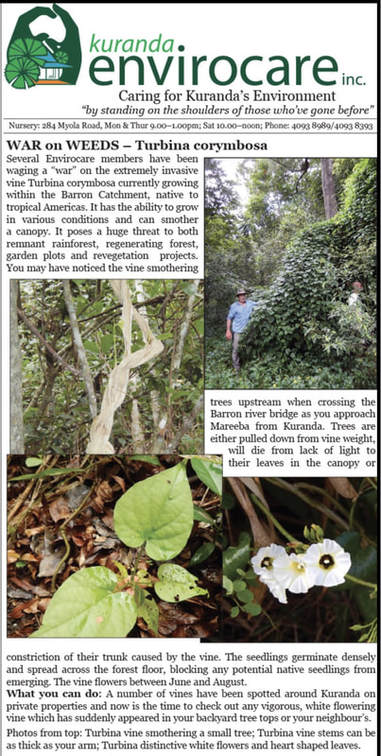
Envirocare's work with invasive weeds

Revegetating in the Wet Tropics has it's challenges unlike anywhere else. 
​

Picture
Excerpt from Kuranda Paper Issue August 2017

Downloadable PDF from the
​Welcome to Kuranda booklet

Your browser does not support viewing this document. Click here to download the document.

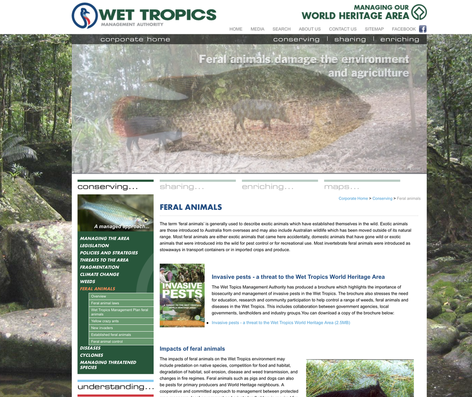
Feral Animals

Visit the Wet Tropics Management Authority (WTMA) website page on feral animals to learn all about how they impact on fragile ecosystems. ​There's also a comprehensive booklet on both invasive flora and fauna that you can download.

http://www.wettropics.gov.au/feral-animals
Picture
Phone
​07 4093 8989

​Email
​Nursery queries
[email protected]

Invasive fauna and flora queries
[email protected]

Online shop queries
[email protected]
​
General queries
[email protected]


Write
PO Box 494 Kuranda 4881


Nursery Address 
284 Myola Rd, Myola , Kuranda 4881
beyond the Kuranda Aquatic centre

Nursery Opening Times
Monday & Thursday 9am - noon 
Saturday 10am - noon 
or ph. 0419 624 940 for appointment
    Subscribe to our newsletter
Subscribe

Newsletter Archive
Check out all previous monthly and biannual newsletters 
Newsletter Archive
  • Home
  • About us
  • Projects
    • Macro invertebrates (What's in our Creeks)
    • Connecting Corridors Project
    • Bird Monitoring Project
    • Frog Monitoring Project
    • Frog Friendly Neighbourhood
    • Yellow Crazy Ants
    • GROW Project 1
  • Nursery
  • Get Involved
  • Shop
  • Tree Planting for Groups
  • Regional planning
    • Land development history
    • Kurworld >
      • TOO BIG
      • WRONG PLACE
      • NOT ENOUGH WATER TOO MUCH WASTE
      • ROAD CONGESTION
      • EMPTY PROMISES
      • NO TRUST
      • KEC Position
      • Resources
      • Submission Form
  • Invasive species
  • Local threatened species
  • Newsletter Archive
  • Contact us
  • Citizen science blog